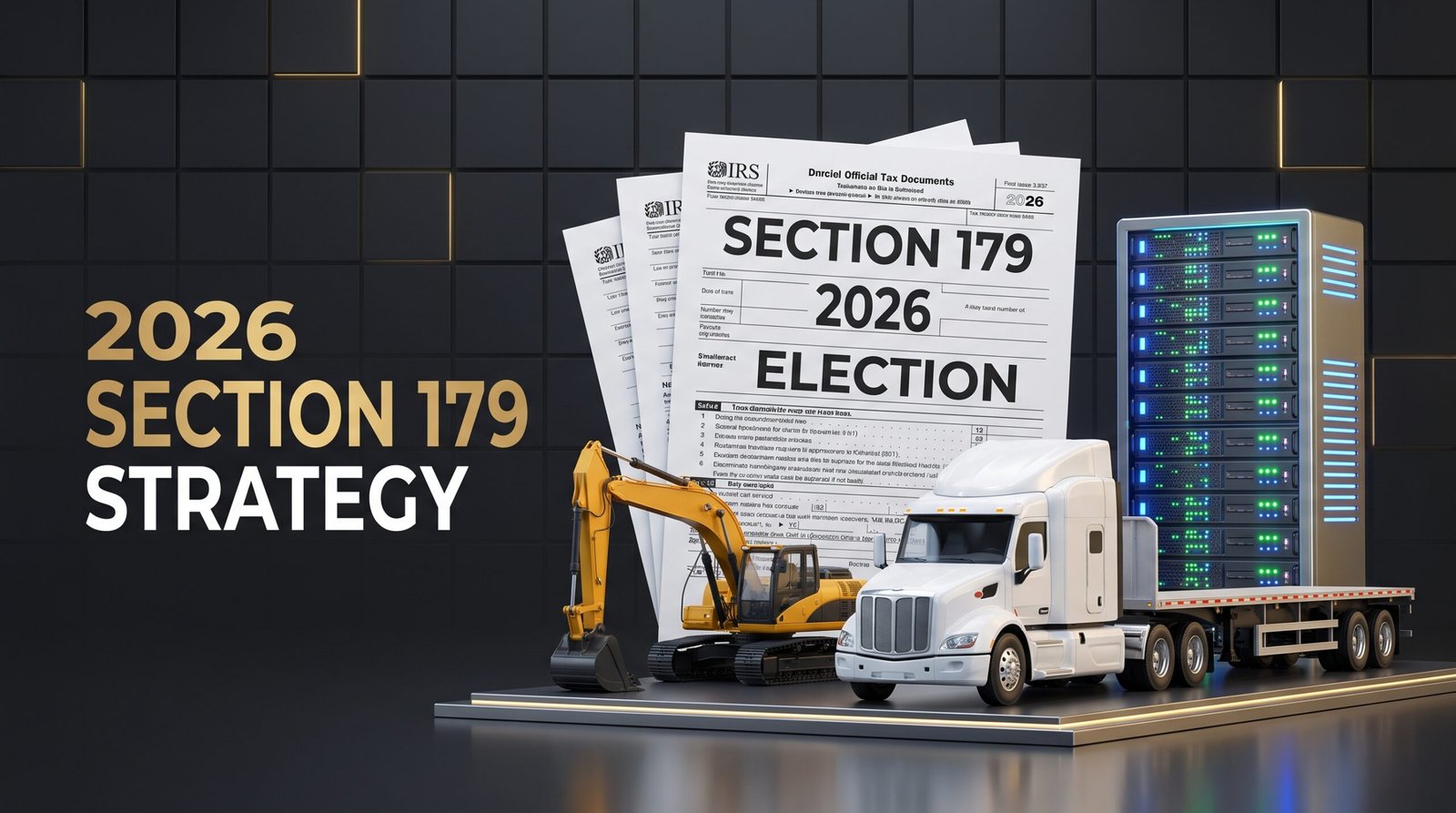

As Q4 progresses, commercial decision-makers face a dual mandate: expand operational capacity for upcoming project pipelines and optimize year-end tax positions. Section 179 of the Internal Revenue Code remains one of the most powerful liquidity drivers available to capital-intensive businesses. However, realizing its maximum tax benefits requires aggressive timeline management and an agile capital allocation strategy.
Understanding the balance between IRS regulatory benchmarks and institutional funding delays is critical for CFOs, General Contractors, Fleet Operators, and Founders acquiring heavy machinery, commercial vehicles, or specialized equipment before the tax year closes.
1. Section 179 Overview: The 2026 Financial Benchmarks
Section 179 allows businesses to deduct the full purchase price of qualifying equipment and software during the tax year it is acquired and deployed, rather than depreciating those costs incrementally over standard MACRS recovery periods.
For the 2026 tax year, the IRS has set the following operational limits:
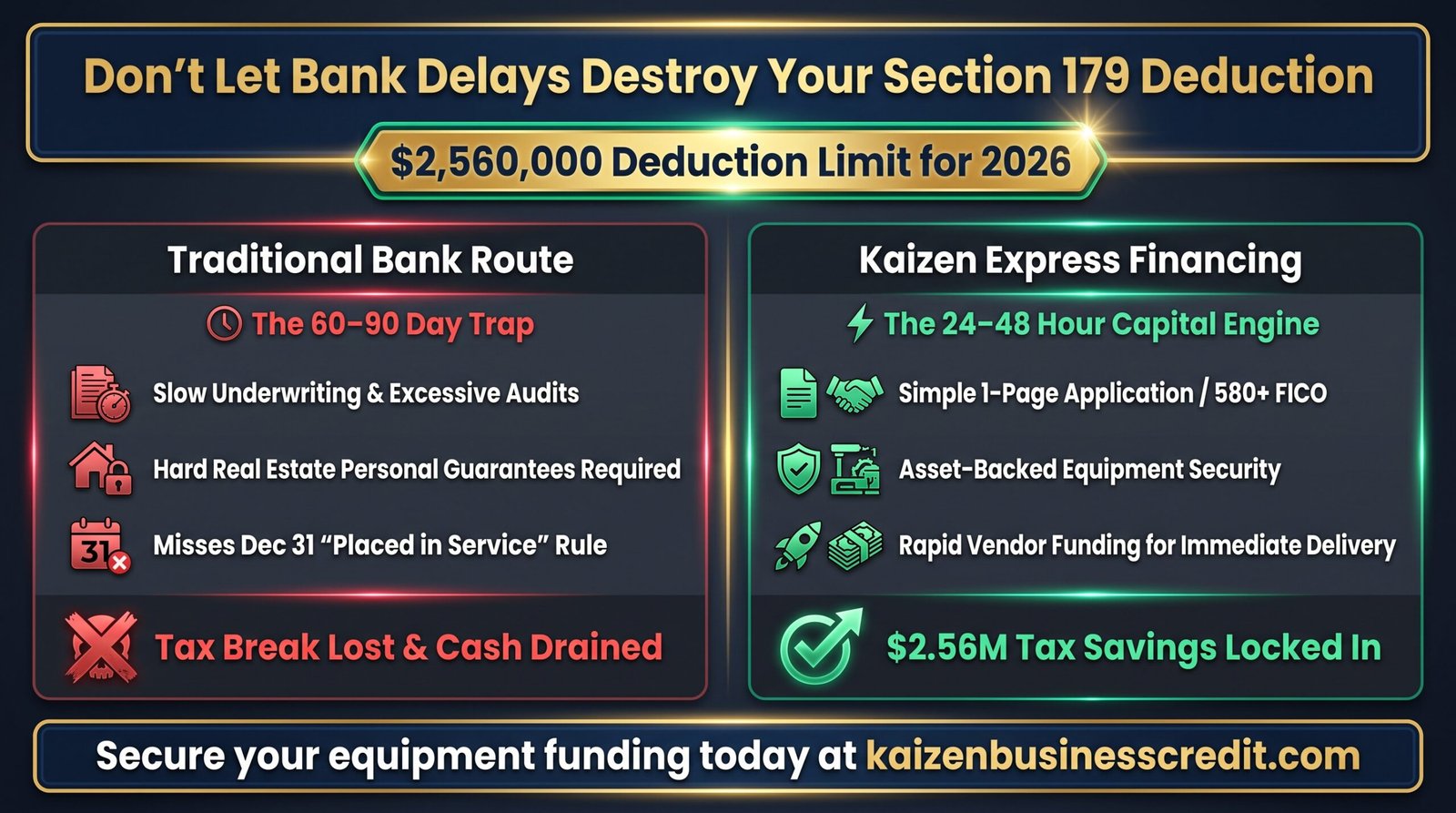
- Maximum Expense Deduction: $2,560,000.
- Phase-Out Threshold: $4,090,000. The deduction limits reduce dollar-for-dollar on equipment purchases exceeding this baseline. Complete phase-out occurs at $6,650,000 in total property placed in service.
- Heavy SUV Cap: Up to $32,000 for qualifying passenger vehicles rated between 6,000 and 14,000 lbs. GVWR
2. The Critical IRS Rule: “Placed in Service”
A common mistake made by finance desks during year-end planning is assuming that executing a purchase order or signing a bill of sale before December 31st secures the tax deduction.
Under Treasury Regulation § 1.168(k)-1, equipment must be physically “placed in service” before midnight on December 31st. The IRS defines “placed in service” as the exact moment property is physically delivered, installed, and in a state of readiness and availability for its specifically assigned function in your business.
- Qualifies: A heavy excavator delivered to a job site, inspected, and ready to dig on December 30th.
- Fails to Qualify: Equipment purchased on December 28th that remains in transit, sitting in a manufacturer’s warehouse, or awaiting site installation on January 1st.
If delivery or operational readiness slips into January, the Section 179 deduction for that asset is deferred to the following tax year.
3. The Bank Timeline Trap vs. Kaizen Express Equipment Funding
Relying on traditional commercial bank debt to fund Q4 capital acquisitions introduces major execution risks.
The Institutional Bank Trap
Commercial banks routinely require 60 to 90 days to process, underwrite, and close equipment loans. Their underwriting processes demand extensive historical tax returns, stringent Debt Service Coverage Ratio (DSCR) audits, and heavy restrictive covenants. Furthermore, banks frequently require hard personal real estate encumbrances, requiring personal guarantees tied to residential property.
Initiating a bank application in Q4 creates significant timeline risk. Approval delays can push vendor payment and equipment delivery past December 31st, causing you to lose current-year tax write-offs.
The Kaizen Non-Bank Advantage
Kaizen Business Credit eliminates underwriting friction through an express capital deployment model built specifically for equipment acquisitions.
| Operational Metric | Traditional Commercial Bank | Kaizen Business Credit |
| Time to Decision / Funding | 60 to 90 Days | 24 to 48 Hours |
| Application Process | Voluminous Audits & Financial Statements | Simple 1-Page Application |
| Personal Guarantee & Collateral | Hard Real Estate Encumbrances Required | Asset-Backed (Equipment Collateral) |
| Use-of-Funds Flexibility | Restricted Covenants | Zero Restrictions (New/Used Asset Suite) |
| Year-End Execution Guarantee | High Risk of Deadlines Slipping | Express Execution for Dec 31 Delivery |
By leveraging asset-backed liquidity, Kaizen Business Credit funds up to $5,000,000 directly to equipment dealers, vendors, or private-party sellers, securing fast asset delivery before the end-of-year tax deadline.
4. Underwriting Matrix & Streamlined Qualification
Kaizen’s equipment financing framework focuses on the collateral value of the asset and overall business health, allowing streamlined underwriting across diverse business profiles.
Product Matrix Guidelines (Equipment Financing)
- Minimum FICO: 580+ Credit Score (flexible based on equipment type and asset valuation).
- Time in Business: No Minimum Time in Business Requirement (Startups eligible with strong comparable credit or industry experience).
- Monthly Revenue: No Minimum Monthly Gross Revenue Floor.
- Capital Cap: Financing available from $10,000 up to $5,000,000.
- Terms: Flexible 1 to 5-year repayment schedules with structured low or zero down payment options.
Required Paperwork for Fast Submission
- Simple 1-Page Application.
- Last 4 Months of Business Bank Statements (if applicable).
- Equipment Invoice, Quote, or Spec Sheet from Vendor/Seller.
5. Strategic Capital Deployment Across B2B Sectors
Kaizen provides financing across a wide variety of equipment types:
- Heavy Construction & Contracting: Earthmovers, excavators, cranes, pavers, skid steers, and specialized tooling.
- Fleet Operators & Trucking: Commercial semi-tractors, trailers, vocational vehicles, dump trucks, and delivery fleets.
- Manufacturing & Industrial: CNC machinery, automated assembly systems, packaging lines, and processing assets.
- Healthcare & Enterprise Tech: Diagnostic imaging systems, surgical suites, specialized office hardware, and enterprise software licenses.
Secure Your Q4 Capital Strategy Today
Do not allow bank delays to compromise your end-of-year tax position or slow down your operational growth. Lock in your Section 179 tax deductions and secure necessary equipment with express funding from Kaizen Business Credit.
Connect directly with our commercial underwriting desk in minutes:
👉 Apply now at kaizenbusinesscredit.com